repair · Aug 16, 2026
Repair as Respect
A cup slipped from my hand in March. I kept the pieces. What mending a broken thing teaches, and why a visible seam says more than a clean one.
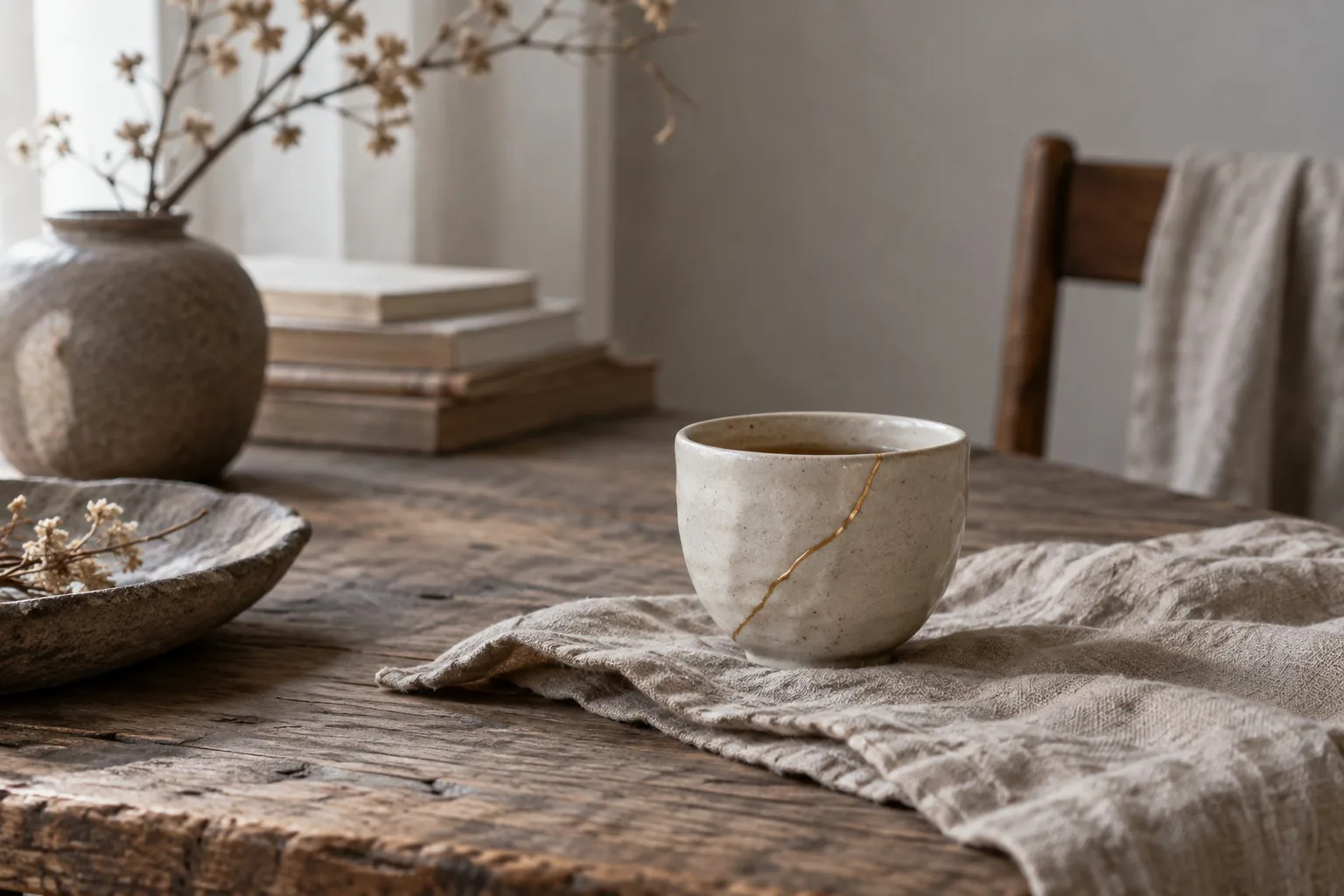
A cup slipped from my hand in March.
It was not a special cup. Grey glaze, a thumbprint near the rim, a small pale chip I had stopped seeing years ago. It broke in three pieces on the stone floor and I stood there for a while.
Then I did not sweep them up.
The pieces
I carried them to the table and laid them on a cloth. Three pieces. Clean breaks. I turned each in my hand and noticed what I had never noticed whole: the clay was thicker at the foot than the lip. The glaze pooled in one place and thinned in another. The maker's hand was still in it.
This is what a broken thing gives you. A look inside.
A very old idea
There is a Japanese craft called kintsugi. A broken bowl is joined with lacquer, and the seam is dusted with powdered gold or silver, so the crack becomes a line of light. One account traces it to around the late fifteenth century. I will not pretend to know its whole history, and I am a beginner at the craft.
What stays with me is the choice. Hide the break, or show it. The first says: this never happened. The second says: this happened, and we kept going.
What mending asks
Patience, first. Lacquer cures slowly, in days and not minutes. You cannot hurry it, and the pieces will not forgive you if you try.
Attention, second. You have to look closely at an edge you would normally ignore. You learn where it fits. You learn how much of the cup is the cup and how much is the space around it.
Then humility. My seam is not neat. It wanders. In one place it is thick, and in another it nearly vanishes. I have stopped apologising for this.
A short list of what I mend now
A bowl with a hairline crack
A wooden spoon, split down the grain
A linen shirt, at the elbow, in a different thread
A chair leg, which took three attempts
A friendship, slowly, by letter
I will say plainly that the last one is not a craft. But the same rules seem to apply.
What the cup is now
It sits on the shelf by the window. It still holds tea. The gold line catches the late light and throws a thin bar across the wall in the afternoon, and I find myself waiting for it.
I used to think a repair made a thing less. Now I think it makes the thing more particular. This cup is not like other cups. It has been dropped, and kept, and mended by hand. That is all it needs to be.
Do not rush to throw away the broken. Lay the pieces on a cloth. Sit for a while.
Then see what they tell you.
No comments yet
Comments are open. Have a thought or a question? Share it below.