ceramics · Sep 02, 2026
The Unevenness of a Handmade Bowl
A good bowl is not a perfect circle. Notes from the wheel on why the slight lean, the thumbprint and the pooled glaze are the reasons I keep a bowl.
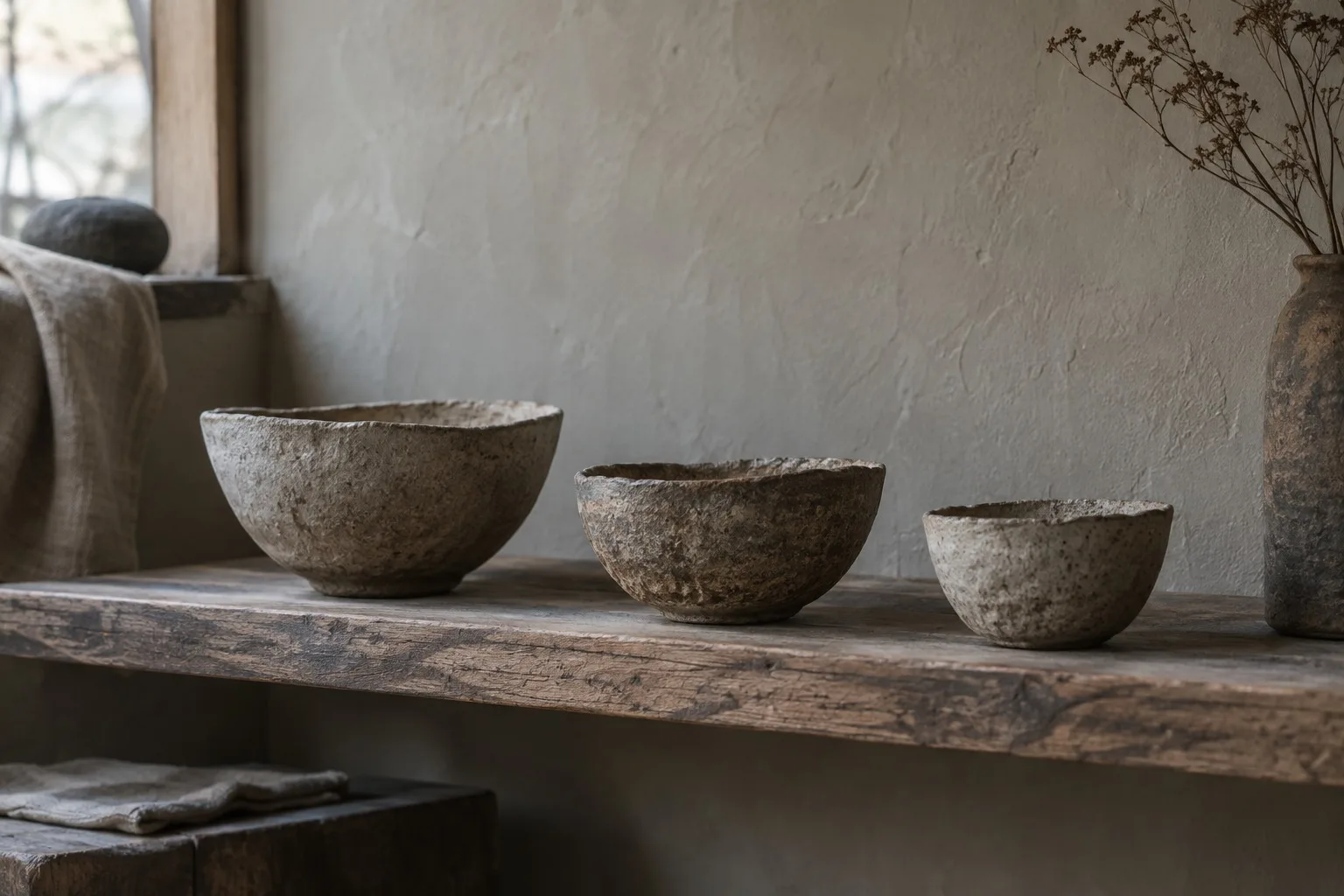
I threw my first hundred bowls trying to make them the same.
I wanted a perfect circle. A rim that lay flat on a table. Walls of even thickness from foot to lip. I measured with callipers. I cut failures in half to check the walls. I was very serious, and the bowls were very dull.
The lean
One day, tired, I let a bowl go. My hands relaxed, the wall leaned a few degrees, and the rim came up slightly higher on one side. I almost crushed it and started again.
I put it aside instead. It dried. It went through the fire. When it came out, it was the first bowl I had made that I wanted to hold.
What the hand leaves
A machine makes a bowl, and the bowl says nothing about how it was made. A hand makes a bowl, and the bowl says everything.
Look closely at one and you will find:
A faint spiral on the inside, where the fingers rose
A slight flat spot, where the bowl rested on the shelf
A thumbprint under the rim
Glaze that thinned over the edges and pooled in the base
A foot that is not quite round
None of these are mistakes. They are a record. They show that a person stood there and worked with clay while it was alive.
Not perfection
I want to be careful. I am not saying that anything crooked is good. Carelessness is not the same as honesty, and a bowl that leaks is a bad bowl. The craft still asks for skill, a lot of it.
What I have learned is to make the skill invisible and the person visible. A well-made bowl sits steady on a table and holds soup. Within that, it is allowed to be itself.
Living with them
I keep a shelf of seconds by the window. Bowls that dipped, tipped or glazed oddly. I eat from them every day.
The one I use most has a rim that rises toward the left like a wave. It fits my hand in a way no machine-made bowl ever has. When I drink soup from it, I turn it slowly, and the light moves along the edge.
I would not swap it for a perfect one.
What the bowl teaches
It teaches me to look for the small thing. A thumbprint, a flaw in the glaze, a place where the clay remembered its shape. It teaches me to leave some things alone.
Most days I try to apply the lesson outside the studio, with mixed success. I am still learning to let a sentence lean. I am still learning to leave a room slightly untidy for a visitor who might be happier that way.
The bowl does not mind. It sits on the shelf, uneven, steady, and full of a quiet light.
No comments yet
Comments are open. Have a thought or a question? Share it below.